Latest Blog Posts


Apr 03
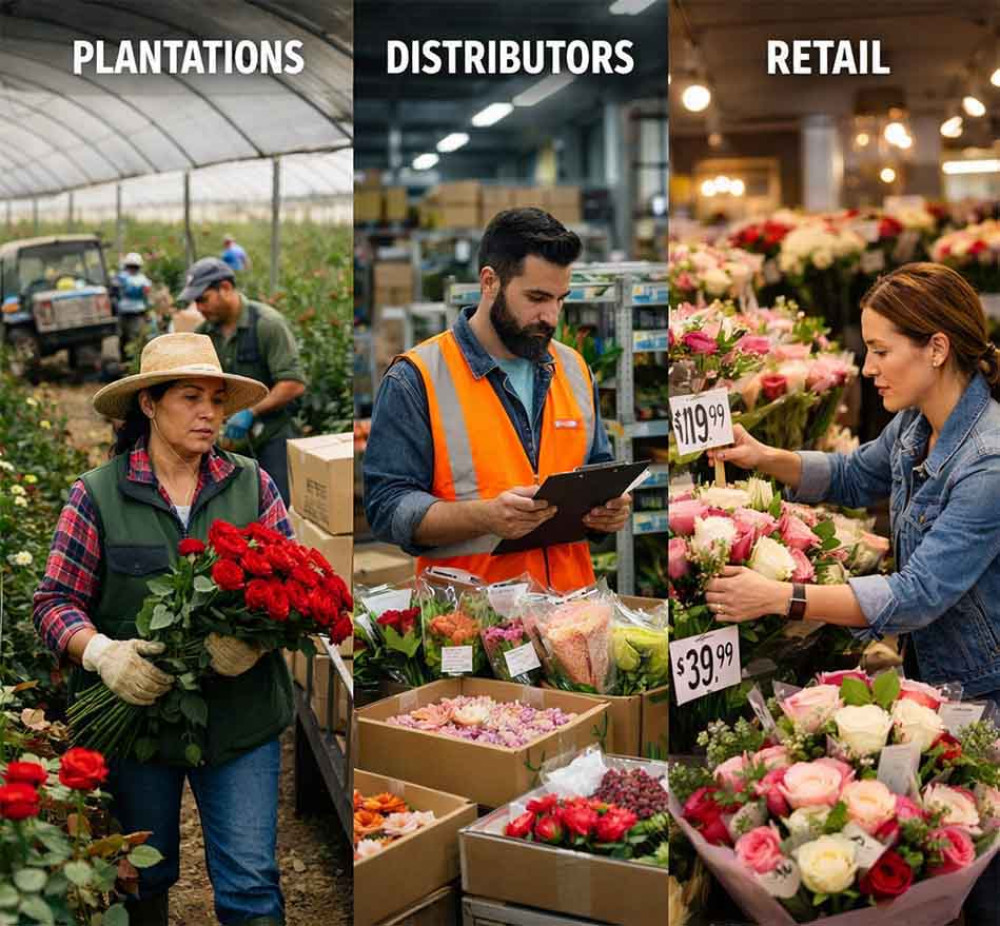
The flower market without romance: who actually earns more — plantations, distributors, or retail.
The flower market has traditionally been perceived as a chain in which each participant performs its own function: plantations grow, distributors deliver, and retail sells to the end customer. On the surface, it seems that money is distributed proportionally to effort and risk. However, in 2026, it is becoming increasingly clear that the real economics of the market are structured differently. Profit does not follow volume, and risks are not always compensated by margin.
The main misconception is that all participants in the chain earn “their share.” In reality, the market operates as a redistribution system in which profit concentrates at points where there is control over the customer, turnover speed, and pricing. Other participants, despite their scale and volume, often operate with limited margins and high dependence on external factors.
To understand who actually makes money, it is important not just to compare participants, but to analyze where value is created and where it is monetized. These points do not coincide, and this is the key feature of the flower market.
Where value is created and where money is earned are different points
Value in the flower business is created at the production stage. This is where the product is formed: the flower is grown, its characteristics, quality, and potential are defined. Without this stage, the market does not exist. However, creating value does not mean monetizing it.
Money appears at the point of sale, when the product is converted into revenue. Between these two points lies the entire chain: logistics, storage, and distribution. At each stage, part of the value is lost. The flower ages, loses quality, and requires costs for transportation and storage. As a result, by the time of sale, its initial value has already been partially diminished.
This means that the participant who creates the product does not necessarily receive the highest profit. And the one who sells it may earn more, despite not being involved in production. This is what makes income distribution in the industry non-obvious.
Plantations: scale is there, control is limited
Plantations form the foundation of the market. They provide volume, stability, and assortment. Their business is built on production efficiency, cost management, and scaling. In 2026, large producers have reached a high level of optimization, allowing them to maintain stable supply.
However, their key problem is the lack of control over end demand. Plantations sell the product but do not control how it will be sold. Pricing is determined by the market, not the producer. This makes them dependent on demand fluctuations and distribution conditions.
An additional factor is competitive pressure. Production is standardized, and differentiation is limited. This means that price becomes the main competitive tool, and margins remain constrained.
As a result, plantations operate with large volumes, but their profitability depends on efficiency rather than pricing power. They create value but do not control its monetization.
Distributors: high turnover, margins under pressure
Distributors occupy an intermediate position between production and retail. Their role is to ensure the movement of goods from plantations to points of sale. This includes logistics, storage, sorting, and distribution.
At first glance, this seems like a profitable position. Distributors handle large volumes and participate in every stage of the chain. However, their margins are under constant pressure from both sides. On one side are producers seeking higher prices; on the other is retail pushing for lower purchase costs.
In addition, distributors bear significant operational expenses. Logistics, cold chain requirements, and storage losses all reduce profitability. At the same time, they do not have full control over the final price.
In 2026, the situation becomes more complex due to market acceleration. Delivery speed requirements are increasing, while sales windows are shrinking. This increases pressure on distributors and reduces their ability to work with buffer stock.
Thus, distributors play a critical role in the system, but their profitability is limited. They ensure the movement of value but are not its primary beneficiaries.
Retail: control over the customer and maximum profit potential
Retail operates at the point where the product is converted into money. This is where the final price is formed and where the purchase decision is made. This gives retail a key advantage — control over the customer.
In 2026, this advantage becomes even more significant. Retail controls not only price, but also presentation, assortment, and the format of the offer. The same flower can be sold at different prices depending on how it is presented. This creates opportunities to increase margins.
However, risks also increase. Retail bears responsibility for unsold goods. If flowers are not sold, the losses fall on the retailer. This makes the business more volatile.
Nevertheless, with proper management, retail has the greatest profit potential. It is closest to the customer and can adapt more quickly to demand, allowing it to offset risks through higher margins.
Why profit is distributed unevenly
The market does not distribute profit evenly among participants. This is because different parts of the chain have different levels of control over key factors: price, demand, and turnover speed.
Plantations control production but not the market. Distributors control the movement of goods but not demand. Retail controls the sale but bears the main risks.
As a result, profit concentrates where there is the ability to influence price and speed of sales. This makes retail the most potentially profitable segment, despite its high level of risk.
How the balance is changing in 2026
In 2026, the balance of power within the chain continues to shift. The growth of digital channels, increased competition, and changing customer behavior make control over sales even more important.
Retail is beginning to play a more active role in shaping demand. It not only sells but also influences customer choice through visual presentation, assortment, and pricing strategy. This strengthens its position.
At the same time, distributors are facing the need to accelerate processes and reduce costs. Their role remains important, but profitability becomes increasingly dependent on efficiency.
Plantations continue to operate under conditions of global competition. Their stability depends on scale and optimization, but opportunities to increase margins remain limited.
Who actually makes money
The answer to this question cannot be definitive when viewed statically. But in the dynamics of the 2026 market, it becomes clear that the greatest profit potential lies with those who control the customer and can manage demand.
This does not mean that retail always earns more. Poor management can lead to losses. However, with an effective model, it is retail that can extract maximum value from the product.
Plantations and distributors remain essential participants, but their income is constrained by the structure of the system. They ensure the functioning of the market but do not define its economics.
Conclusion: the market belongs to those who control the sale
The flower market in 2026 is not just a supply chain. It is a system in which profit is distributed based on control over key points: the customer, price, and turnover speed.
Plantations create the product, distributors ensure its movement, but retail turns it into money. And it is precisely there that the main opportunity for profit is formed.
The key conclusion is that in the modern market, it is not those who produce more who win, but those who sell better. And this is what is reshaping the very logic of the business.
Your experience matters! Take a short survey and see what answers other flower business representatives gave. Take part